
Understanding the Vagus Nerve, Breathwork, and Neuroplasticity in the Lives of Immigrants
Ozge Aksut Department of Psychology · Working Paper
Abstract
For many immigrants, the body remembers what the mind tries to forget. Long after the suitcases are unpacked and a new language is learned, the nervous system continues to operate as though the journey is not yet over. This paper explores how chronic stress, displacement, and cultural adjustment shape the vagus nerve — the body’s principal calming circuit — and how intentional breathwork can serve as a bridge to neuroplastic change. Drawing on a real-life narrative and recent findings in polyvagal theory, the paper argues that breath is not merely a relaxation technique, but a culturally accessible, low-cost, and evidence-supported pathway to nervous system regulation, particularly for individuals navigating the long psychological tail of migration.
Keywords: vagus nerve, breathwork, neuroplasticity, polyvagal theory, immigrant mental health, trauma, nervous system regulation
Introduction
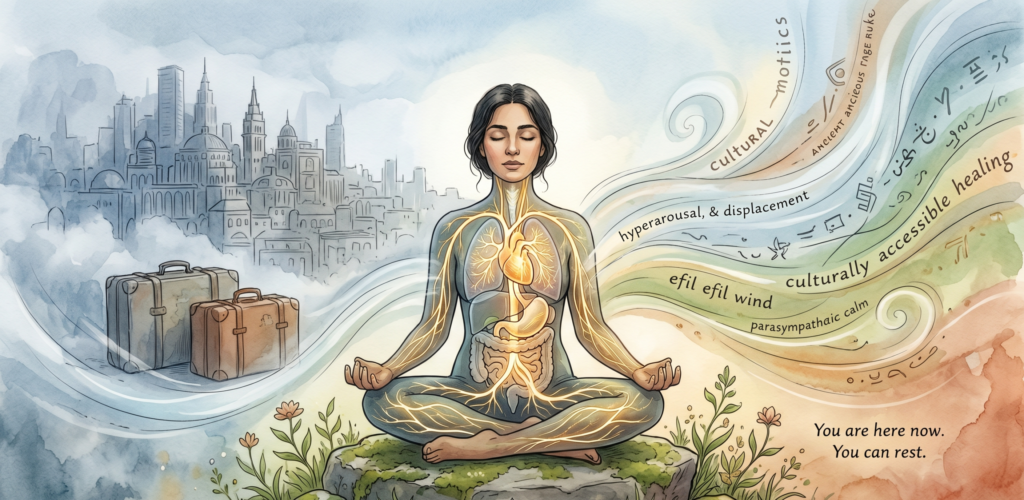
Leyla arrived in Toronto on a winter morning, with two suitcases and a teaching diploma that would not be recognized in her new country. She was forty-one. In the city she had left behind, she had been a respected high school literature teacher; in this new one, she was, for a long time, no one in particular.
What she did not expect — what no orientation pamphlet had prepared her for — was the way her body began to behave. Her heart raced when the doorbell rang. Her sleep fractured into small, restless pieces. A trip to the grocery store could leave her trembling for hours. A friend told her she should “just relax.” A doctor told her she had anxiety. Both were correct, in their way, and both missed the deeper truth: Leyla’s nervous system was still running the marathon she thought she had finished.
Stories like Leyla’s are not unusual. They are, in fact, statistically ordinary. And they point to a part of human physiology that mental health care has only recently begun to take seriously: the vagus nerve, and its quiet, consequential role in how we recover — or fail to recover — from prolonged stress.
The Vagus Nerve: The Body’s Internal Diplomat
The vagus nerve is the longest cranial nerve in the human body. It travels from the brainstem down through the throat, heart, lungs, and digestive organs, carrying information in both directions. Roughly eighty percent of its fibres are afferent — meaning they send signals up from the body to the brain — which means the body is, in a very literal sense, talking to the mind far more than the mind is talking to the body.
When the vagus nerve is functioning well, the body settles after a stressor: heart rate slows, digestion resumes, the face softens, social engagement returns. This capacity is often measured through vagal tone, indexed by heart rate variability (HRV). Higher vagal tone is associated with greater emotional flexibility, better immune function, improved sleep, and a stronger sense of safety in the body.
When vagal tone is chronically low — as it often is in people exposed to prolonged stress, trauma, or displacement — the nervous system tends to remain stuck in two modes: hyperarousal (anxiety, racing heart, hypervigilance) or hypoarousal (numbness, fatigue, dissociation, depression). Stephen Porges’ polyvagal theory describes these as defensive states the body adopts when it has not yet received the internal signal that the danger has passed.
For immigrants, refugees, and members of culturally displaced communities, this signal is often delayed by years. The threats that triggered the original stress response may be physically distant, but the body — never having been told otherwise — continues to brace.
Why Migration Lives in the Body
Migration is rarely a single event. It is a sequence of overlapping stressors: the pre-migration uncertainty, the transit itself, the loss of language and status, the rebuilding of identity in a place that does not yet recognize you. Each of these phases leaves a physiological imprint.
Several factors make immigrant nervous systems particularly vulnerable to dysregulation. There is the chronic uncertainty of visa processes, credential recognition, housing instability, and financial precarity, which all extend the body’s stress response far beyond its natural recovery window. There is the loss of co-regulation that comes when extended family, neighbours, and familiar community routines are left behind — an essential layer of nervous-system soothing quietly removed. There is the cultural mismatch in care, where standard mental health interventions may not feel safe or familiar, leading individuals to delay or avoid help. And there are the cumulative micro-stressors: accent-related judgments, navigating bureaucracy in a second language, and small daily acts of cultural translation that accumulate into a steady physiological load.
Leyla’s grocery store panic, in this light, was not irrational. It was a nervous system doing exactly what it had been trained to do — staying alert in a world that had, for years, demanded alertness.
Breath as the Vagus Nerve’s Native Language
If the vagus nerve is the body’s diplomat, breath is the language it speaks most fluently.
Among all the autonomic functions the vagus nerve participates in, breathing is the one human beings can directly and consciously influence. This makes it one of the few accessible doorways into a system that is otherwise involuntary. Slow, diaphragmatic breathing — particularly with extended exhalation — has been shown to increase vagal tone, reduce cortisol, and shift the nervous system toward a parasympathetic state.
The mechanism is elegant. With each exhale, the heart rate naturally slows; with each inhale, it slightly accelerates. By lengthening the exhale relative to the inhale, the body sends a clear, repeated message upward through vagal afferents: we are safe enough to rest. Over time, this message begins to shape the brain’s expectations.
Several breath patterns have particularly strong evidence behind them. Resonance breathing — roughly six breaths per minute, with equal or slightly extended exhalation — has been linked to improved HRV, reduced anxiety, and better emotional regulation. Extended-exhale breathing, such as a four-count inhale and a six- to eight-count exhale, reliably activates the parasympathetic branch. And coherent humming or chanting, common in many spiritual traditions, stimulates the vagus nerve through vibration in the throat and has measurable effects on vagal tone.
What is striking is how many of these patterns already exist within traditional cultural practices. The slow breath of prayer. The repetitive cadence of zikr. The drawn-out vowels of song. The deliberate breath of yoga and qi gong. Long before science had a name for the vagus nerve, cultures had built rituals that worked with it.
Neuroplasticity: How Repetition Becomes Identity
Neuroplasticity is the brain’s capacity to reorganize itself in response to experience. Once thought to be limited to childhood, it is now understood to continue across the entire lifespan. Every repeated thought, behaviour, and physiological state strengthens certain neural pathways and weakens others — a principle often summarized as neurons that fire together, wire together.
This is both the difficulty and the hope.
The difficulty: a nervous system that has spent years in survival mode has, quite literally, built itself around survival. Pathways for vigilance, threat detection, and self-protection are well-rehearsed. Pathways for rest, trust, and openness may have grown faint from disuse.
The hope: those pathways can be rebuilt. Not through willpower, and not through insight alone, but through repeated experience of a different state. Each time the nervous system is guided into a calmer, regulated state — through breath, through safe relationship, through ritual — the brain takes a small step in that direction. With enough repetition, that direction becomes a road. With more repetition still, it becomes the default.
This is why brief, daily breathwork tends to outperform occasional, longer sessions. It is not the duration that matters most; it is the frequency with which the nervous system gets to practice safety.
For someone like Leyla, this reframing changes everything. Her body is not broken. It is simply well-trained in something she no longer needs. And it can be retrained — gently, gradually, in her own language and on her own terms.
A Culturally Grounded Practice
One of the quiet gifts of breath-based work is that it does not require translation. It does not depend on cultural fluency in psychological vocabulary. It does not ask a person to narrate their pain in a second language before relief is permitted. The breath belongs to everyone, and every culture has, in some form, already been working with it.
For immigrant communities, this matters. A breathing practice can be introduced through what is already familiar: prayer, song, traditional movement, a grandmother’s advice to “take a deep breath before you answer.” It can be done at home, in private, without cost, and without the stigma that still surrounds formal mental health care in many communities.
When paired with culturally competent therapy — and, where appropriate, with the wisdom of traditional healing practices — breathwork becomes not a standalone fix but a daily anchor. It is the small, repeatable practice that holds the larger work in place.
Conclusion
The vagus nerve does not care which country a person was born in, which language they dream in, or how many borders they have crossed. It responds to the same simple inputs across all of us: slow breath, safe presence, gentle repetition. For immigrants whose nervous systems have spent years preparing for a danger that is no longer present, this is more than a clinical observation. It is an invitation.
Leyla, in time, found her way. Not through a single intervention, but through a slow accumulation of small ones — a few minutes of slow breathing in the morning, a walking group in her neighbourhood, a therapist who understood why a grocery store could feel like a battlefield. Her heart rate variability, measured a year later, had risen. Her sleep had returned. The doorbell no longer startled her in the same way.
Her body, finally, had begun to believe what her mind had been trying to tell it for years: you are here now. you can rest.
This is the quiet promise of working with the vagus nerve. Not that suffering will disappear, but that the nervous system — given the right conditions, in any language, in any culture — remains capable of learning a new way to be at home.
This is a condensed version of the working paper. The full text, along with other research and academic writings, is available on my Academia.edu profile.