
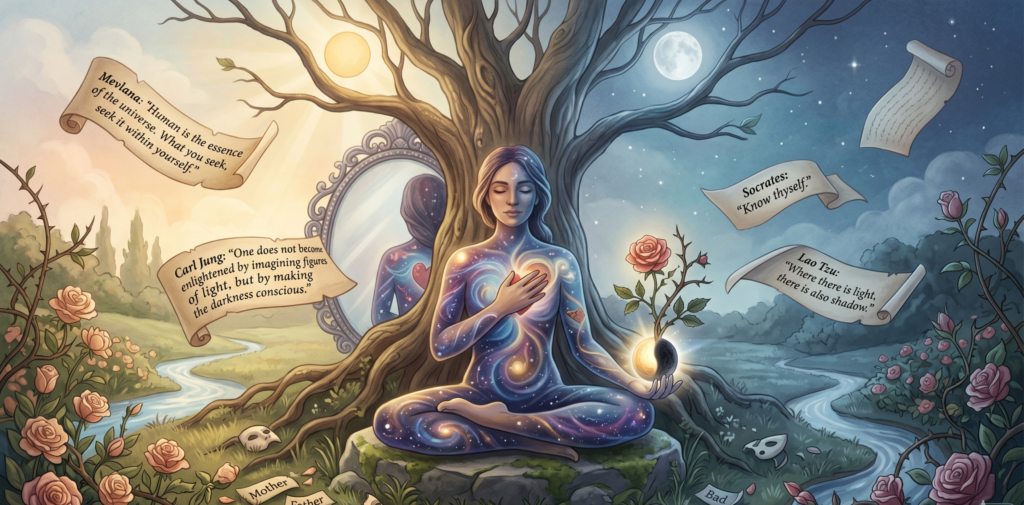
One is whole — with mind, intellect, ego, self, heart, and soul. Although we try to make sense of these elements separately, the human being possesses a harmony within the wholeness of their existence. Yet when one fails to grasp the essence of this nature, one cannot embrace one’s own being with love and compassion.
The human is like a river; sometimes overflowing and tumultuous, sometimes calm and still… Society tries to shape the bed of this river. From the moment we are born, we are taught what we must and must not do.
While we are asked to refrain from acts such as lying, stealing, and slander, virtues like honesty, helpfulness, and good character are presented to us as ideals. Yet these teachings create an inevitable conflict within the human being. One sometimes finds oneself in an act they themselves reject, and sometimes experiences inner turmoil upon seeing others engage in such acts.
So, can these tremors be an invitation for the human to discover their true nature?
The human is like a universe. A being endowed with infinite possibilities, holding within both light and shadow. One must recognize these contradictions within oneself and accept them without judgment. For only a truth that is accepted can be transformed. The human who denies their own nature also denies their own existence and thus cannot realize their potential.
Consider a dog… It is whole with its barking, its loyalty, and sometimes even its biting — and these are accepted as parts of its nature. Yet the human struggles to accept the contradictions and various aspects within themselves.
The human is like a garden; within it grow both roses and thorns. If we admire the fragrant flowers but fear and try to destroy the thorns, do we not disturb the nature of the garden?
True wisdom, however, lies in accepting both the roses and the thorns.
And the shadows of the human…
As long as the human denies their shadow side, they will remain in conflict with it. Every emotion, every aspect they avoid accepting, takes hold of them unknowingly and grows stronger. The more one runs from the darkness within, the more that darkness is empowered. Yet the moment the human recognizes their shadows and approaches them with love and compassion, they reach an inner balance. When the light and the darkness within dance together, the human begins to consciously direct their own existence. They become aware of their choices, take responsibility for their actions, and grasp the true meaning of free will. Free will enters precisely here. Within the human exist the seeds of both good and evil. So, which seed shall we water? Which one shall we allow to grow?
Society expects people only to be good. But the truth we have forgotten is this: every human carries all potentials within.
Our rigid expectations of others turn into disappointments. The same is true for our notions of mother, father, child, and friend. We expect a mother to be only compassionate and self-sacrificing; yet a mother is also a human being, and within her too lie all potentials. The reason we feel disappointed when our expectations are not met is our effort to fit human beings into narrow molds.
When we look into a mirror, are we watching the reflection we wish to see, or the truth?
Confining people into molds is like placing a mask upon a mirror and trying to alter its true image. Yet the human is a whole — existing in all the colors of their soul, independent of labels. When we are able to see a person simply as they are, a transformation begins within us as well.
We then look at both ourselves and others from a wider perspective, and by accepting the realities of life, we develop a deeper understanding.
So, can we have the courage to look at our own shadows?
Are we ready to face our darkness in order to discover our own light? To understand the human is to understand life. And life only opens the doors of inner peace when we accept it without judgment…
Philosophical and Spiritual Perspectives
Great thinkers and spiritual teachings have offered profound insights into the nature of the human being:
Mevlana Jalaluddin Rumi: “The human is the essence of the universe. Whatever you seek, seek it within yourself.”
Socrates: “Know thyself.” For the human to discover their own nature is the foundation of a conscious life.
Carl Jung: “One does not become enlightened by imagining figures of light, but by making the darkness conscious.” The human can only grow when they accept both the darkness and the light within.
Lao Tzu: “Where there is light, there is also shadow.” Accepting the contrasts within human nature is the key to finding inner balance.
From these perspectives, we may conclude that the human must embrace both their light and their shadow. Only through this acceptance can one recognize true freedom and one’s true potential.
“Whatever a person sees and judges in the outside world, they actually judge within themselves as well — but they are not aware of it. What they cannot love in the outer world, they cannot love within themselves either.”
“One cannot accept in others what one cannot accept within oneself.”
“The love, attention, and worth one cannot receive from outside, one cannot offer to oneself either — nor can one give it to others.”
“Every emotion we feel toward another is, in truth, a reflection of how we view ourselves.”
İlknur Aksüt Çilingir