
Exploring Pathways for Culturally Competent Mental Health Care
Ozge Aksut
Department of Psychology
Working Paper
Abstract
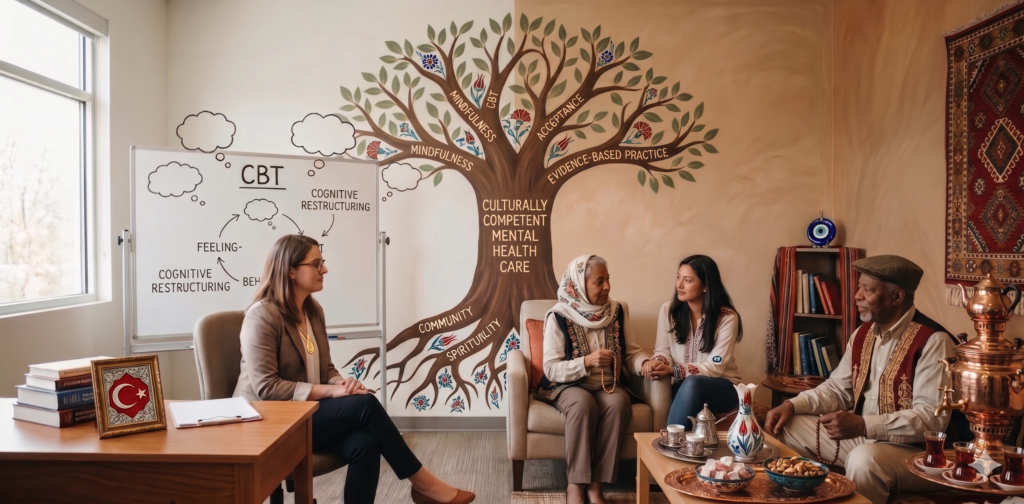
The integration of Cognitive Behavioral Therapy (CBT) with traditional healing practices presents promising pathways for enhanced mental health care, particularly in culturally diverse populations. CBT is widely valued for its evidence-based, structured approach to reshaping dysfunctional thoughts and behaviours, while traditional healing offers a holistic framework that addresses the mind, body, and spirit through community-oriented practices, rituals, and cultural beliefs. This paper explores how combining CBT techniques with the holistic elements of traditional healing — mindfulness, family involvement, and spiritual dimensions — can advance culturally competent mental health care.
Keywords: CBT, ACT, traditional healing, integration, depression, anxiety, therapeutic alliance, cultural competence
Introduction
Traditional healing encompasses a broad spectrum of practices and belief-based patterns developed across different cultures over centuries. It can be broadly categorized into two streams: traditional healing practices (such as massage, acupuncture, and spiritual healing) and traditional medicine (the use of natural substances and plant-based remedies). Both rest on local knowledge and address the root causes of illness rather than only its symptoms.
In many socio-cultural contexts, traditional healers are highly respected figures who exert significant influence within their communities. The World Health Organization estimates that around 80% of the global population relies on some form of complementary and alternative medicine, illustrating its widespread acceptance.
Traditional Healers and Mental Health Care
In many regions — especially across Africa and parts of the Middle East — traditional healers are often the first professionals approached by individuals facing mental health challenges. They are seen as culturally relevant and accessible sources of care, often filling the void left by formal mental health services.
The holistic approach taken by traditional healers — which incorporates spiritual, psychological, and social dimensions — resonates with patients who view mental illness through a cultural lens. However, this pathway can also lead to delays in receiving appropriate biomedical care, particularly for severe disorders where timely intervention is crucial.
Despite these challenges, traditional healers hold a unique position: their cultural authority and trusted relationships within communities make them potentially valuable partners in formal mental health systems.
CBT Meets Traditional Healing
Cognitive Behavioral Therapy (CBT) is a structured, evidence-based approach focused on identifying and reshaping unhelpful thoughts and behaviours. Traditional healing, in contrast, is rooted in cultural, spiritual, and communal frameworks.
Though their methods differ, both approaches share a common goal: alleviating psychological distress. Several intersection points create real opportunities for integration:
- Mindfulness and acceptance — present in both traditions
- Breathing meditation — used by traditional healers for spiritual balance, by CBT therapists for anxiety management
- Addressing avoidance — through exposure (CBT) or communal/spiritual processes (traditional)
- Therapeutic alliance — built on trust in both frameworks
The development of “third wave” CBT therapies — particularly Acceptance and Commitment Therapy (ACT) — has narrowed the gap by integrating mindfulness and acceptance strategies that align naturally with traditional healing philosophies.
Why This Integration Matters
CBT, while highly effective, often operates within a primarily Western framework that may not fully resonate with people from diverse cultural backgrounds. Traditional healing, on the other hand, is deeply embedded in local culture but often lacks scientific validation.
By integrating both:
- CBT becomes more culturally sensitive and accessible
- Traditional healing gains scientific legitimacy
- The therapeutic alliance is strengthened through cultural respect
- Mental health care addresses mind, body, and spirit together
- Community and family are brought into the healing process
This is particularly significant for indigenous, immigrant, and underrepresented communities, where cultural identity and community ties are inseparable from individual well-being.
Comparison Table: CBT, Traditional Healing & The Integration Path
| Aspect | Cognitive Behavioral Therapy (CBT) | Traditional Healing Methods | How CBT Can Be Improved |
|---|---|---|---|
| Cultural Sensitivity | Primarily Western framework; may not resonate with diverse backgrounds | Deeply rooted in local culture; respects traditional beliefs | Incorporate cultural beliefs to enhance client engagement |
| Holistic Approach | Focuses on thought patterns and behaviours | Integrates spiritual, emotional, and communal dimensions | Address mind, body, and spirit together |
| Community Involvement | Primarily individual-focused | Emphasizes community support and collective healing | Involve families and social support systems |
| Mindfulness & Acceptance | Structured techniques can be rigid | Promotes mindfulness and acceptance | Integrate mindfulness for emotional regulation and resilience |
| Avoidance Behaviors | Uses exposure techniques | Addresses avoidance through communal and spiritual processes | Combine perspectives for richer interventions |
| Therapeutic Alliance | Relies on the clinician-client relationship | Built through cultural relevance and community ties | Foster collaboration with traditional healers |
| Non-Pharmacological Care | Mainly cognitive and behavioural techniques | Herbal remedies, spiritual practices, non-invasive methods | Include traditional remedies for psychological and physical care |
| Training for Healers | Requires formal, standardized training | Lacks rigorous scientific evaluation | Train traditional healers in CBT principles |
| Spirituality in Treatment | Generally secular | Emphasizes spirituality in healing | Integrate spirituality where culturally meaningful |
| Research & Evidence Base | Extensive empirical validation | Limited scientific validation | Collaborate on integrated outcome research |
Conclusion
The integration of traditional healing methods into Cognitive Behavioral Therapy offers a meaningful opportunity to advance mental health care — making it more comprehensive, culturally sensitive, and accessible. By recognizing the strengths of both paradigms — the structured precision of CBT and the holistic depth of traditional healing — practitioners can build therapeutic approaches that honour cultural identity while remaining grounded in evidence-based practice.
This synergy is not about replacing one system with another, but about creating a richer, more inclusive framework where mind, body, spirit, and community are addressed together. The path forward lies in collaboration, mutual respect, and a willingness to expand what we mean by “evidence” and “healing.”
This is a condensed version of the working paper. The full text, along with other research and academic writings, is available on my Academia.edu profile.